
If you've been training for a few months and your lifts haven't moved, the problem usually isn't your genetics, your supplements, or your split. It's that nothing about your training has been getting harder.
Progressive overload is the single most important principle in strength training, and it's also one of the simplest to understand. Here's what it means, how beginners can apply it without overthinking it, and the mistakes that quietly stall progress.
What progressive overload actually means
Your body adapts to the demands placed on it. Lift a certain weight for a certain number of reps, and your muscles and nervous system adjust until that effort feels manageable. To keep getting stronger, the demand has to increase gradually over time. That gradual increase is progressive overload.
The word "weight" misleads a lot of people here. Adding load is only one way to do it. You can also add reps, add sets, slow the tempo, improve your range of motion, or shorten your rest. All of them make the same muscle work harder than it did last time.
The good news for beginners
Beginners have an advantage that disappears later: almost any consistent, reasonably structured training produces visible progress in the first few months. Your nervous system learns to recruit muscle more efficiently, and small increases show up quickly.
That means beginners don't need an elaborate system. They need a simple, repeatable one, applied consistently.
Five ways to progress, from simplest to most advanced
1. Add reps. If your target is three sets of eight to twelve reps, start at eight on each set. When you can hit twelve on every set with good form, it's time to move to the next method.
2. Add weight. Once you reach the top of your rep range, increase the load by the smallest practical amount, commonly two to five percent or the smallest plate your gym offers, and drop back to the bottom of the rep range. This pairing of reps then weight is often called double progression, and it's one of the most beginner friendly systems there is.
3. Add sets. Moving from two sets to three, or three to four, increases total work for a muscle group. Do this gradually, since more volume also needs more recovery.
4. Slow the tempo. Lowering a weight over three or four seconds makes the same load considerably harder without adding a single plate. This is especially useful for bodyweight training and when small plates aren't available.
5. Improve quality. Deeper range of motion, a pause at the bottom, or cleaner form on the same weight all count as progression too, and they often protect your joints better than simply adding load.
A simple weekly example
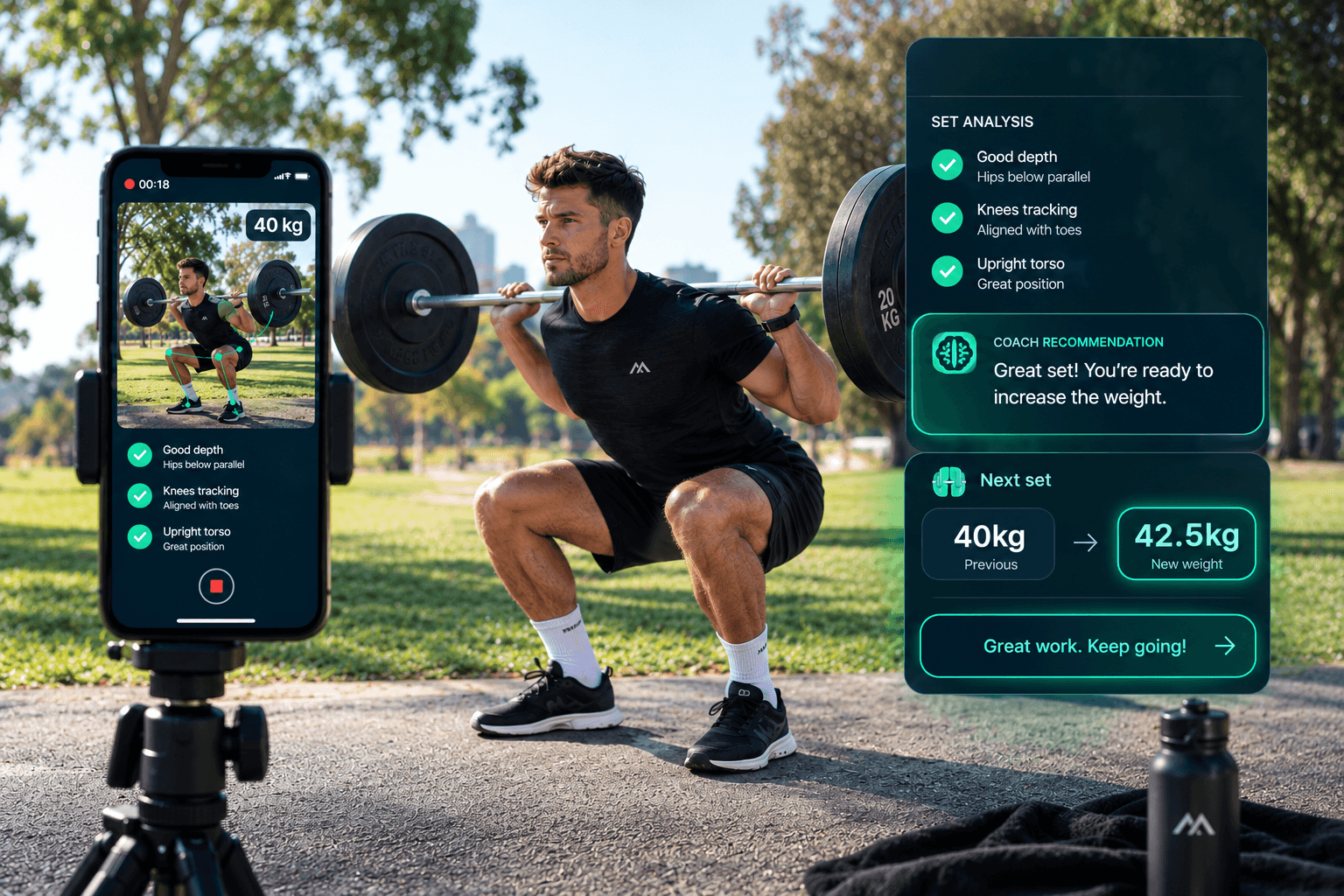
Say you're squatting and your target is three sets of eight to twelve reps.
- Week 1: 40 kg, sets of 8, 8, 8
- Week 2: 40 kg, sets of 10, 9, 8
- Week 3: 40 kg, sets of 11, 10, 10
- Week 4: 40 kg, sets of 12, 12, 11
- Week 5: 42.5 kg, back to sets of 8, 8, 8
Nothing about this is dramatic, and that's the point. Small, repeatable steps compound over months.
The mistakes that stall beginners
Changing the program too often. Rotating exercises every week means you never get a clear comparison point. Keep your main lifts consistent for at least four to eight weeks so you can actually see progress.
Not tracking anything. If you can't remember what you lifted last week, you can't beat it. A logbook or app removes the guesswork.
Chasing weight with sloppy form. A heavier lift done badly isn't progress. It's a faster route to an injury and a stall.
Skipping recovery. Strength is built while you rest, not while you train. Sleep, protein, and enough total food matter just as much as the session itself.
Expecting every week to be a personal best. Progress isn't a straight line. Some weeks the same weight feels heavier because of poor sleep or stress, and a repeat of last week's numbers is still a perfectly good result.
Where personalized programming helps
The hardest part of progressive overload isn't understanding it. It's knowing, session by session, how much to increase and when to hold steady, especially when your recovery, schedule, and equipment keep changing.
This is the job of Michael, MVPeak's strength focused coach. Your plan is built around your starting point and goals, then adjusted based on what you actually log, so the increases arrive when you're ready for them rather than on a fixed calendar. If you're training at home with limited gear, the equipment scan means progression options like tempo and rep changes are built into your plan automatically, so you aren't stuck when the next plate isn't available.
FAQ
What is progressive overload in simple terms? It means gradually making your training harder over time, through more weight, reps, sets, slower tempo, or better quality, so your body keeps adapting and getting stronger.
How often should a beginner increase weight? There's no fixed schedule. A good rule is to increase the load once you can complete all your sets at the top of your rep range with good form, which for many beginners happens every one to three weeks on major lifts.
Can you get stronger without adding weight? Yes. Adding reps, sets, slowing the tempo, and improving range of motion all increase the demand on your muscles, which is why bodyweight training can still build strength.
What if I stop progressing? Check your sleep, food intake, and recovery first, then confirm you're actually tracking your lifts. Plateaus often resolve with a short lighter week, a small change in rep range, or simply a few more days of consistency.
Want your progression handled for you, session by session? Michael builds your strength plan around where you are today and adjusts it as you get stronger. Try it free for 7 days. Find My Coach →
Related read: The No Equipment Home Workout That Actually Builds Muscle (No Gym, No Excuses), for progression ideas when you don't have a barbell.
Keep reading
View all posts
Training
The No Equipment Home Workout That Builds Real Muscle
No equipment? No problem. Build real muscle at home with a plan that adapts to whatever space and gear you actually have on hand.

Training
·5 min readBest AI Fitness Apps in 2026: An Honest Comparison Guide!
Not all AI fitness apps are equal. Here's an honest comparison of the main types, who each suits best, and where each one falls short.

Training
·5 min readTraveling for Work? Here's How to Keep Training Without a Gym or a Plan Falling Apart!
Work travel doesn't have to wreck your training. Here's how to keep progressing from a hotel room, with no gym and no equipment!
mvpeak
Put the reading into practice
Every coach on this blog trains members in the app, with plans, sessions and meals built around your week.
No credit card required · Cancel any time